01 / SORTING↗
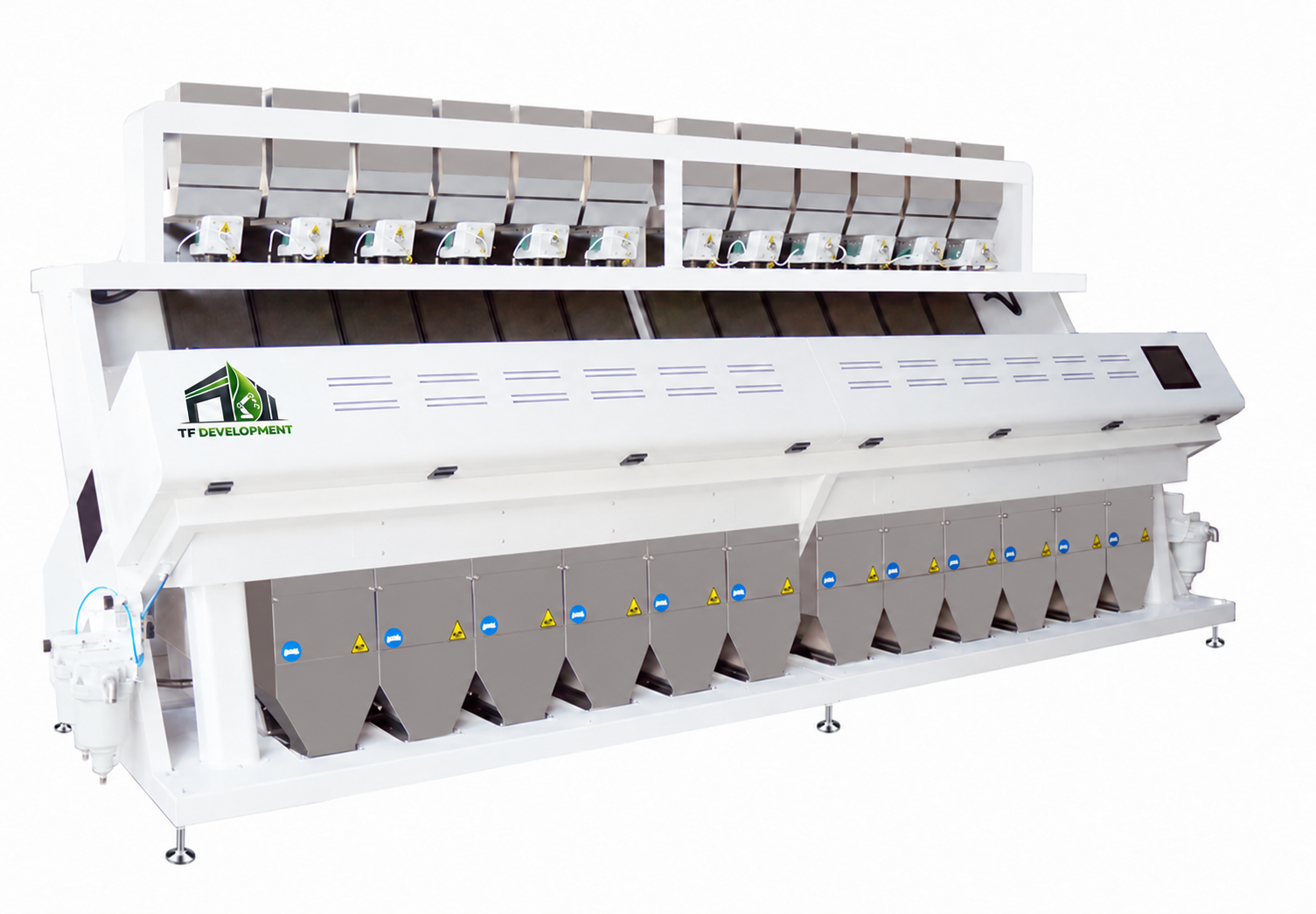
Optical sorters
22 models. Catalogue throughput from 0.5 to 22 t/h. Selection based on material, particle size and required purity.
View models and specifications ↗
Machines, production lines and robotics.
From concept to implementation.
Plastics, rubber and non-ferrous metals — technology selected for the material properties, stream composition and target product.
Sorters and separators are selected for different materials and mixtures. The application depends on feedstock properties and the fraction to be recovered or removed.
Also for the food industry. We offer equipment selection for sorting food products and removing contaminants, taking into account product properties, hygiene requirements and suitability for food contact.
22 models. Catalogue throughput from 0.5 to 22 t/h. Selection based on material, particle size and required purity.
View models and specifications ↗Recovery of non-ferrous metals and their separation from plastics, rubber and other material streams. Equipment selected for feed composition, particle size and feeding conditions.
Material composition, particle size range, moisture content, metal content and target throughput. Feed preparation and even material distribution are also considered.
Removal of ferromagnetic contaminants from plastics, rubber and non-ferrous metal streams. Magnetic separation also enables ferrous metal recovery and protects downstream equipment. Designs suitable for food applications can remove ferromagnetic contaminants from food products.
Material type, burden depth, conveyor speed, contaminant size and available installation space.
Size reduction and preparation for subsequent processing stages. Configuration tailored to the feedstock and final product.
Feed properties and size, target particle size, throughput and integration with conveying, dust extraction and separation equipment.
Size reduction before further processing. Cutting systems selected for the feedstock characteristics and process load.
Feedstock type and dimensions, possible contaminants, output particle size, loading method and throughput requirements.
Solutions for processing rubber waste. Selection of shredding, separation and fraction preparation stages for further use.
Rubber waste type, steel and textile content, target particle size and product purity. The line configuration depends on the feedstock and required throughput.
Preparation and processing of aluminium cans. Shredding, cleaning and separation combined into a coordinated system.
Incoming feedstock form, contamination level, target product form and throughput. The processing stages are defined for each application.
Equipment for moulding rubber products. Press selection based on the process, mould dimensions and required production cycle.
Platen dimensions, pressing force, daylight opening, stroke, temperature and number of working levels. Loading arrangements and control requirements are also considered.
Mix preparation for rubber product manufacturing. Solutions selected for the ingredients, batch size and production workflow.
Ingredient types, batch volume, required mixing time and discharge method. The dosing system is selected according to the formulation and process.
Solutions for preparing mixes and forming rubber cylinders for further processing, including cutting into rolled rubber matting.
Cylinder diameter and height, mix composition, curing method and subsequent cutting requirements. The line is configured for the target product.
Transport of products and components between workstations. Conveyors supplied as standalone units or as part of a complete line.
Product dimensions and weight, conveyor length, working height and drive type. Integration with other equipment is taken into account.
Need several machines integrated into one line? Let’s start with your feedstock and production goals.
Explore line design ↗We design the process around your material, target product and available space. Equipment selection goes hand in hand with planning material flow between operations.
Describe your line ↗Define the feedstock, final product and required throughput.
Select the machines and sequence of process operations.
Plan equipment positions, material handling and integration within the building.
Agree on the configuration, responsibilities and delivery terms.
We offer autonomous solutions, robotic workstations and autonomous warehouses. The scope of automation is tailored to material flow, working practices and existing infrastructure.
Autonomous transport of materials, containers and products between production workstations and the warehouse.
Robot selection based on payload and transport routes; planning pickup, delivery and charging points.
Solutions for machine tending, product handling, palletising and repetitive production operations.
Selection of the robot, gripper and workstation equipment to suit the product, required cycle time and operating conditions.
Systems supporting automated storage, retrieval and goods transport, as well as material flow between warehousing and production.
Warehouse layout planning, equipment selection and definition of integration with controls and the warehouse management system.
Every project starts with a process analysis. Configuration, safety requirements and the scope of integration are defined individually for each facility.
Discuss your automation project ↗We import machinery from China and other countries. Your process specification is the starting point and guides our equipment search.
We define the parameters and equipment your plant needs.
We compare solutions against the application and delivery conditions.
Testing, documentation, transport and commissioning are specified individually in the offer.
TF DEVELOPMENT combines machinery engineering and supply with practical manufacturing knowledge. We select individual machines, design complete lines and develop robotics and autonomous solutions around the needs and economics of each process.
Our work covers plastics, rubber and non-ferrous metal recycling, as well as rubber product manufacturing. We also offer sorting and separation technologies for other sectors, including food processing. We start with the material and the required outcome, and judge a solution by how well it serves the plant in everyday operation.
Active in manufacturing since 2000, Tomasz brings 26 years of experience spanning engineering, plant construction and development, and many years in production management, particularly in the rubber and recycling industries. He studied at Lublin University of Technology.
He combines a technical perspective with hands-on responsibility for day-to-day plant operations. At TF DEVELOPMENT, he applies this knowledge to machinery selection, process optimisation and automation, taking throughput, quality, maintenance and operating costs into account.
Prepare a brief description of your needs. Your material, target throughput and final product provide the basis for equipment selection.
ul. Leśniczówka 17i
24-320 Poniatowa
Poland
Tax ID (NIP): 717 153 75 55
+48 733 100 743tfiuk@tfdevelopment.plDownload your enquiry brief and send it to our email address. This form does not send data automatically.